LOOKING PAST THE HYPE: AN INVESTOR’S GUIDE TO IPOS
BACKGROUND
A wave of potential or widely discussed future high-profile IPOs (e.g., SpaceX, OpenAI, Anthropic, if pursued) are generating significant investor interest. These are companies with strong growth narratives, dominant positions in emerging industries, and a level of visibility that naturally draws investor curiosity. For many clients, the appeal is intuitive: the opportunity to “get in early” on what could become defining companies of the next decade.
But that framing, while compelling, tends to obscure an important point. History suggests IPOs are often underwhelming entry points for investors because of how and when public investors are able to invest in such opportunities. IPOs historically underperformed the broader public market in their early years, even after adjusting for comparable size and style. This is not a short-term anomaly or a function of market cycles, rather a dynamic observed across multiple market periods.
WHAT IS AN IPO?
An IPO, or initial public offering, is the process by which a private company offers shares to the public for the first time. It allows the company to raise capital from a broad base of investors and marks the transition from private to publicly traded status. Once listed, shares trade on a stock exchange and are available for purchase by everyday investors.
WHAT DOES HISTORY TELL US ABOUT IPO INVESTMENTS?
Historically, IPOs underperformed comparable publicly listed companies, a dynamic that is well documented in studies going back to the 1980s and still holds today. Even in cases where IPOs ultimately go on to succeed, the early experience for investors is rarely smooth. In the sample of largest U.S. IPOs since 2000 (see below), each experienced a drawdown of at least 10% within its first year of trading, with a median maximum drawdown exceeding 50%. While this is a limited sample, it reinforces how even the largest, high-profile public offerings have historically been accompanied by significant volatility.
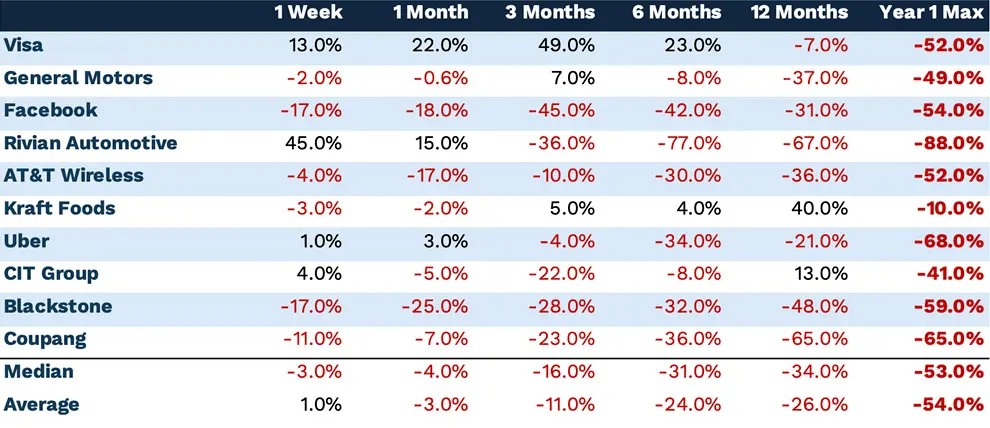
Understanding why this happens is an important nuance. IPO pricing often reflects a high degree of optimism, with valuations that already embed strong expectations for growth and execution. At the same time, the supply of publicly available shares is initially limited, with insiders and early investors typically subject to lockup periods. It creates a dynamic where demand outstrips supply in the early days, but where additional shares gradually enter the market over time, often putting pressure on prices. These dueling forces layer into the nuance of the business, limited public market operating history and prevailing macro forces, it becomes clear why early price discovery can be both volatile and uneven.
ARE THERE ANY POTENTIAL BENEFITS TO BUYING AN IPO?
There are reasons IPOs attract investor attention, but the risks are notable and worth understanding clearly.
Potential benefits:
Early access to companies with strong growth narratives or market leadership in emerging industries
The possibility of price appreciation if the company executes well and the market assigns a higher valuation over time
Key risks:
Early trading is often volatile, and elevated expectations can make the initial risk/reward profile less attractive
Many newly public companies are not yet profitable. For example, the combined SpaceX and xAI entity generated losses of $4.94 billion last year on revenue of $18.67 billion
Valuations at IPO often reflect a significant premium relative to peers, implying a high level of embedded optimism that may or may not be justified
Allocation uncertainty is common. Even when retail platforms participate, demand for high-profile IPOs far exceeds supply, and investors typically receive only a fraction of what they request
CONCLUSION
Bringing this together, the tension around IPO investing is evident. Underlying companies can be attractive, and in many cases, they go on to play an important role in markets, portfolios and the economy. But the IPO itself, meaning simply the moment when shares first become publicly available, is rarely the most favorable point of entry.
As investors, this context creates an opportunity to reframe the conversation. Rather than focusing on access to a specific transaction we should frame it as if, when, and how we choose to gain exposure to the underlying business. In many cases, a measured approach which allows the company to transition into the public markets, for liquidity to improve, and for valuation to adjust, can lead to a less volatile path to ownership. In that sense, IPOs become less about missing an opportunity, and instead about understanding the timing of when an opportunity naturally transitions into a portfolio without creating a negative drag.