STRENGTH AND RESILIENCY IN U.S. EQUITY EARNINGS
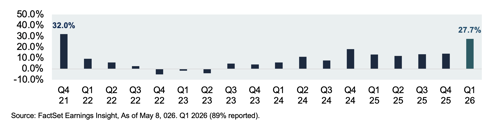
First quarter (or “Q1”) 2026 earnings season has been the strongest in nearly five years. Blended year-over-year earnings per share (or “EPS”) growth for the S&P 500 is tracking at 27.7% (with 89% reporting), the highest since Q4 2021 and more than double the 13.1% expectation at quarter end. If realized, it would mark the index’s 6th consecutive quarter of double-digit growth and its strongest quarter since Q4 2021.
S&P 500 Y/Y QUARTERLY EARNINGS GROWTH
Mega-cap technology continues to disproportionately lift headline earnings. Strong results from Alphabet, Amazon, Meta and Microsoft drove most of the upside, lifting the "Magnificent 7" earnings growth to 61% versus 16% for the rest of the index. AI capital spending continues to set the pace. Hyperscaler capital expenditures (or “capex”) commitments for 2026 climbed to roughly $751 billion, an 83% increase from 2025 spending. That investment is feeding through to revenue and earnings momentum at chipmakers, infrastructure providers and select industrials, while at the same time raising legitimate questions about returns on capital. Another important note this quarter is the share of “other income” contributing to the growth. Nearly 60% of net income for Google and Amazon came from valuation increases to private company holdings such as Anthropic.
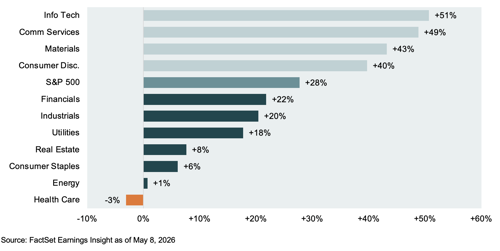
Looking deeper at specific sectors, seven of eleven S&P 500 sectors are reporting double-digit year-over-year earnings growth. Information technology (+51%), communication services (+49%), materials (+43%), and consumer discretionary lead the index. NVIDIA and Micron Technology were key drivers within information technology, benefiting from strong AI-related demand for semiconductors. Health care is the only sector showing year-over-year declines. Beneath the surface, results were broader than the headline numbers suggest. Industrials and Financials posted a solid quarter with positive guidance, and more broadly companies reported the lowest frequency of EPS misses in 25 years (excluding COVID).
Q1 2026 S&P 500 EARNINGS GROWTH BY SECTOR
Equities responded constructively and the risk-on tone was visible across global markets. Beneath the surface, however, the reward for individual EPS beats has been unusually small. The median company beating consensus outperformed the index by just 20 basis points the day after reporting, one of the smallest readings on record.
S&P 500 EPS SURPRISE VS. AVG PRICE CHANGE
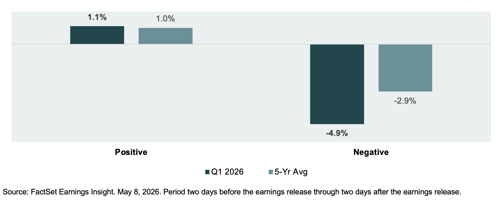
On the other hand, companies with negative earnings surprises were disproportionately punished. That suggests good news was largely priced in. Capital spending also outpaced share repurchases by a wide margin, with capex up over 40% year-over-year in Q1 versus a 1% increase in buybacks, something that warrants monitoring. Strong earnings remain the primary support for current valuations. The S&P 500’s forward P/E of 21x sits above its five-year average of 19.9x and ten-year average of 18.9x, but the multiple is more digestible if 2026 earnings deliver the 21% growth analysts now expect. The path to that outcome requires margins to hold and AI capex to continue translating into revenue. There are risks to this, particularly around margin compression. Tariffs, energy costs and wage pressures could erode the profitability gains analysts are projecting. And market concentration combined with elevated valuations leaves less margin for disappointment.